Foundation repair
Foundation Repair Across Cache Valley and Northern Utah
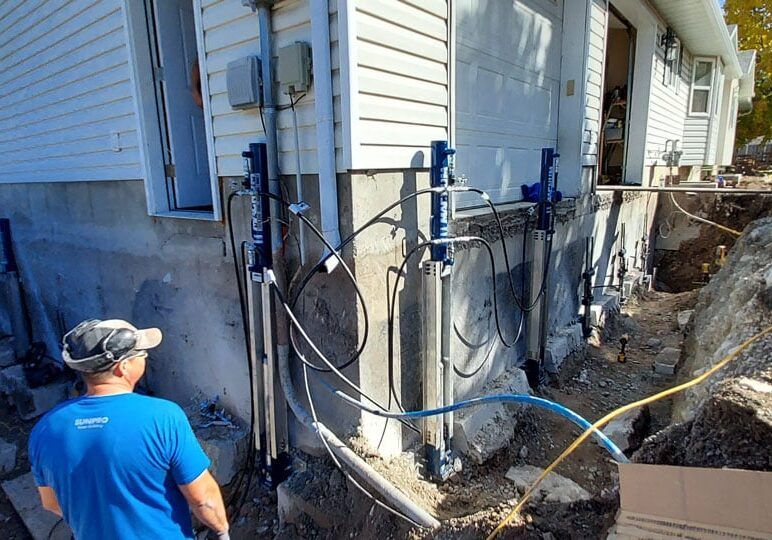
When a foundation settles and a house starts to sink, Poly-Lift lifts and stabilizes it with push piers and helical piles driven down to solid support. Signs include cracks in exterior walls, doors and windows that stick, and sloped floors. Most foundation jobs take one to two days and you can stay in your home while we work.
What foundation lifting and piering is
Foundation lifting saves a sinking foundation before the damage spreads. Left alone, a settling foundation can let water seep through cracks and leave walls bowing or crumbling.
Piering is the technique of driving steel pipe pilings down to solid ground to stop the settlement and lift the structure back where it belongs. It is a permanent fix, not a patch.
Push piers or helical piles: which does your home need?
Both are permanent fixes Poly-Lift installs, and the right one depends on your soil and your structure: push piers fit tight spaces, while helical piles do not work well in the gravel and cobble found in parts of Cache Valley. We help you choose at your free estimate.
| Push piers | Helical piles | |
|---|---|---|
| How it goes in | Steel pier sections driven hydraulically into the ground | A large steel screw turned into the ground |
| How deep | Down to bedrock or another stable surface | Typically 20 to 60 feet, set by engineers |
| Room to install | Fits tight, narrow spaces with no heavy equipment | Needs more room to install than push piers |
| Soil | Rests on bedrock, not on friction against the soil | Works in a wide variety of soils, but not well in gravel, rock and cobble |
| How the support is checked | Each pier is load-tested using the weight of your home | An engineer or the manufacturer sets how many piles, put in by a certified installer |
Backed by Magnum Piering
We partnered with Magnum Piering, one of the best lifting supply companies in the industry, because they have a team of engineers behind every product. Their systems are ICC-ES proven and ISO 9001 certified, and their piers are built from new structural steel rather than recycled pipe.
Poly-Lift moved into foundation lifting after years of concrete work, when we saw how many of our customers, including homeowners up on the hills around Bear Lake, had settling foundations. Reach out for a free estimate and we will help you decide between push piers and helical piles.
Six ways to tell your foundation needs lifting
If you spot a few of these, it is worth a free look before it gets worse.
Settling soil
Homes built on or near a slope need extra care. If the ground beneath is giving way, lifting can bring the foundation back to level.
Broken footings
When the footings at the base of your foundation break from lack of support, settlement follows. Look for cracks running up the foundation wall.
Slanted mortar lines
Brick is laid level. If the mortar lines are no longer straight, that unevenness is a clear sign of settlement.
Visible cracks
Watch for cracks in drywall, plaster, or the basement floor inside, and stair-step or long horizontal cracks in the brick outside.
Sticky doors and windows
As a foundation shifts it changes the angle of the frames. A four-foot level on the frame will tell you if it has moved.
Uneven floors
A basement floor that is out of level usually means settlement or heave. Uneven wood floors can mean settlement or sagging joists in a crawl space.
Foundation Repair FAQ
How long does foundation repair take?
Most foundation jobs take one to two days. Larger jobs can run up to five days.
Can I stay in my home during foundation repair?
Yes. You can keep living in your home while we install push piers or helical piles. The work happens from outside the structure.
What is the best foundation repair method?
Push piers or helical piles are the best methods for lifting and stabilizing a settled foundation. Which one fits depends on your soil and the weight of the structure, and we help you decide.
What are the signs of a bad foundation?
Cracks in exterior walls, doors and windows that will not shut properly, sloped floors, and sunken landscaping around the house are the common warning signs.
Should I buy a house that needs foundation repair?
It can be a sound purchase if you are prepared to have the repair done. Get an assessment first so you know the scope and cost going in.
Does homeowners insurance cover foundation repair?
Usually not. Most homeowners policies treat settling as maintenance and exclude it. Coverage sometimes applies when a sudden event such as a burst pipe or flood caused the damage, so it is worth a call to your agent. If it is not covered, financing is available.
Do you offer financing?
Yes, financing is available. Ask when you call for your free estimate and we will walk you through it.
Should I get push piers or helical piles?
It depends on your soil and your structure. Push piers are driven hydraulically down to bedrock and fit tight spaces, while helical piles screw in 20 to 60 feet deep to an engineer's spec and work in a wide range of soils, but not well in gravel and cobble. We help you choose at your free estimate.
Guides
Related services
What customers say
Have used polylift to lift a foundation and a concrete floor. Did great work at both and reasonably priced. Will definitely work with them again if I need concrete lifting services.
Get a free estimate for foundation repair
Every job starts with a free on-site look and an exact price before any work begins.
Service area
Serving Cache Valley and Northern Utah
One local crew, based in Logan. We travel across the valley and beyond for concrete lifting and foundation repair.